Updates
News & Blog
News, achievements, and job posts from Neuroflight Lab.
← Back to all news
 News
June 10, 2026
News
June 10, 2026
News
June 10, 2026
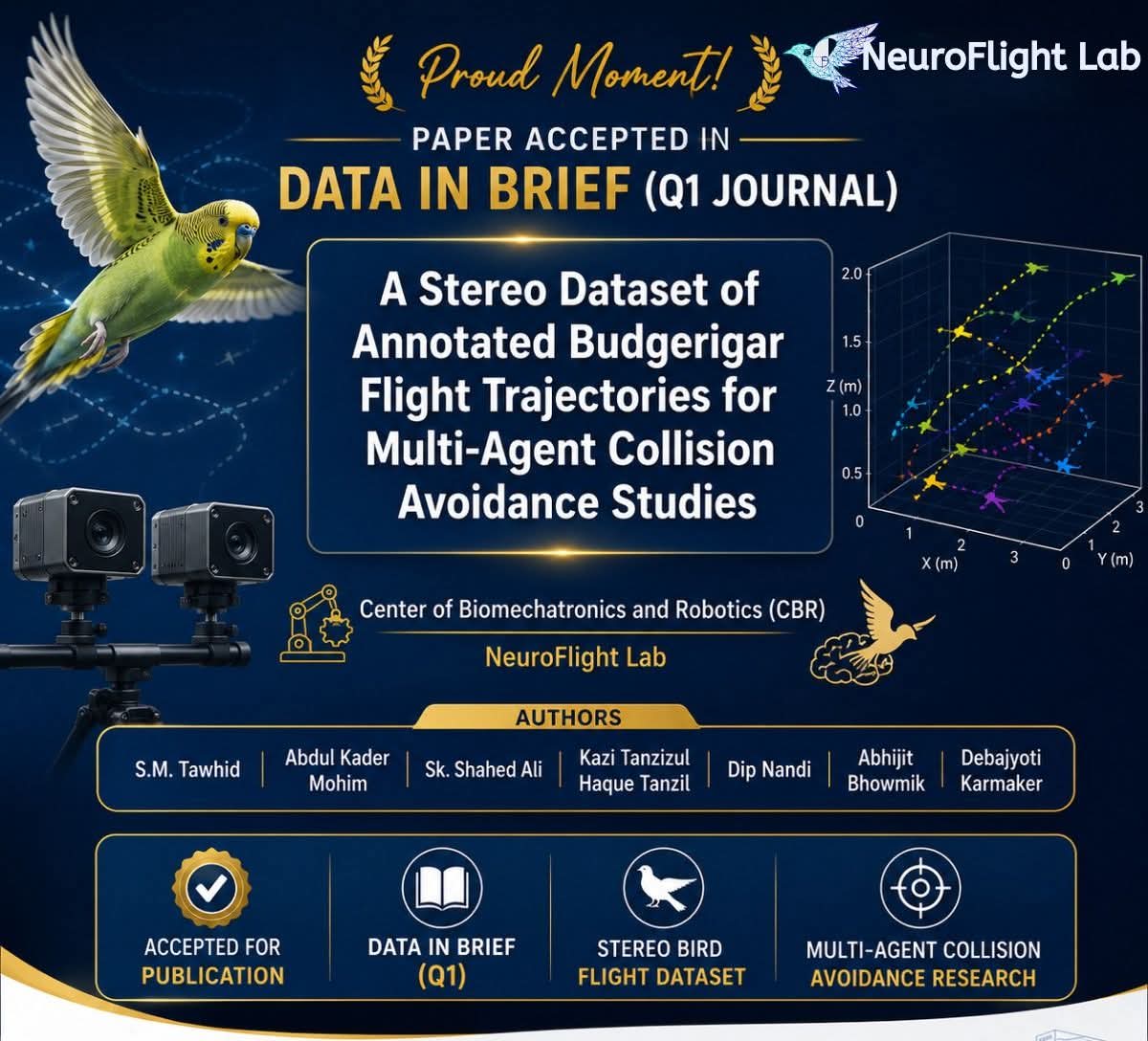
We are delighted to share that our research paper
“A Stereo Dataset of Annotated Budgerigar Flight Trajectories for Multi-Agent Collision Avoidance Studies”
has been accepted for publication in Data in Brief (Q1 Journal).
This work introduces what is, the world's first publicly available stereo-vision dataset of annotated budgerigar flight trajectories specifically designed for multi-agent collision avoidance research. The dataset captures complex bird flight interactions in 3D and provides a unique benchmark for researchers working in:
🔹 Bio-inspired robotics
🔹 Swarm intelligence
🔹 Autonomous navigation
🔹 Computer vision and tracking
🔹 Multi-agent collision avoidance systems
🔹 Animal flight behaviour analysis
By bridging biology and engineering, this dataset offers new opportunities to study how flying agents naturally avoid collisions and how those principles can be translated into next-generation autonomous systems.
👨🔬 Authors:
S.M. Tawhid, Abdul Kader Mohim, Sk. Shahed Ali, Kazi Tanzizul Haque Tanzil, Prof. Dr. Dip Nandi, Abhijit Bhowmik, and Dr. Debajyoti Karmaker
We extend our sincere gratitude to all collaborators, mentors, and members of NeuroFlight Lab and the Center of Biomechatronics and Robotics (CBR) for their continuous support.
This achievement marks an important step toward advancing bio-inspired intelligence and safer autonomous multi-agent systems.
has been accepted for publication in Data in Brief (Q1 Journal).
This work introduces what is, the world's first publicly available stereo-vision dataset of annotated budgerigar flight trajectories specifically designed for multi-agent collision avoidance research. The dataset captures complex bird flight interactions in 3D and provides a unique benchmark for researchers working in:
🔹 Bio-inspired robotics
🔹 Swarm intelligence
🔹 Autonomous navigation
🔹 Computer vision and tracking
🔹 Multi-agent collision avoidance systems
🔹 Animal flight behaviour analysis
By bridging biology and engineering, this dataset offers new opportunities to study how flying agents naturally avoid collisions and how those principles can be translated into next-generation autonomous systems.
👨🔬 Authors:
S.M. Tawhid, Abdul Kader Mohim, Sk. Shahed Ali, Kazi Tanzizul Haque Tanzil, Prof. Dr. Dip Nandi, Abhijit Bhowmik, and Dr. Debajyoti Karmaker
We extend our sincere gratitude to all collaborators, mentors, and members of NeuroFlight Lab and the Center of Biomechatronics and Robotics (CBR) for their continuous support.
This achievement marks an important step toward advancing bio-inspired intelligence and safer autonomous multi-agent systems.